

The Prime Maturity Growth Gap: Why Women 40+ Are the Most Undervalued Market in the Global Economy
For the past decade, growth strategy has been built around a familiar narrative:
focus on the next generation.
Gen Z. Digital natives. Emerging behaviors.
But while companies have been looking ahead, they have overlooked something far more immediate — and far more valuable.
One of the most powerful growth segments in the global economy is already here.
And it is being systematically undervalued.
Women over 40.
A Market Hiding in Plain Sight
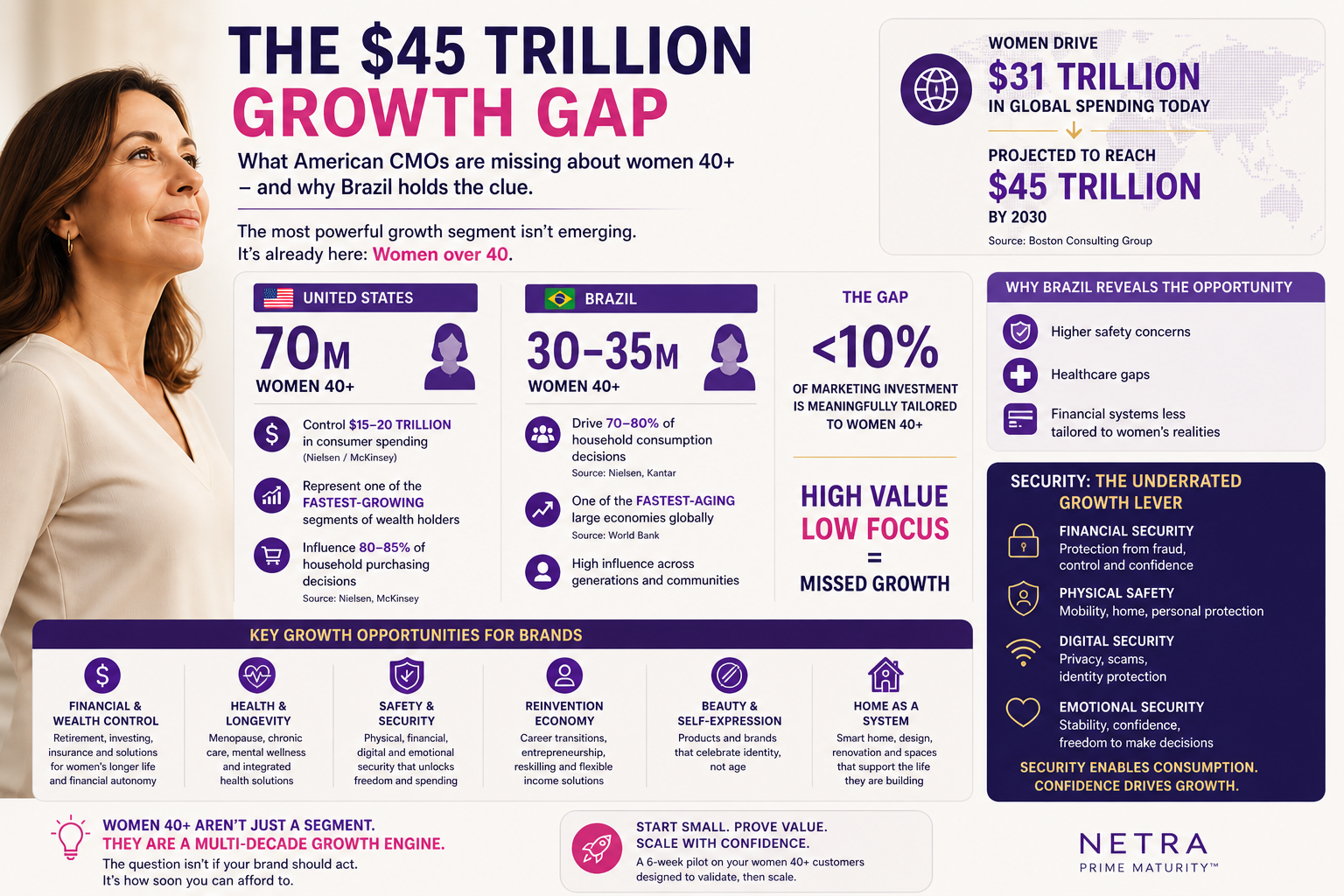
Women already control approximately $31 trillion in global consumer spending, a figure projected to reach $45 trillion by 2030.
In the United States alone, there are roughly 70 million women over 40, representing one of the fastest-growing segments of wealth holders.
In Brazil, the picture is equally compelling:
30–35 million women over 40
Influence over 70–80% of household purchasing decisions
A rapidly aging population reshaping the future consumer base
This is not a niche.
This is a multi-decade, multi-market growth engine.
And yet, most organizations are not structured to see it that way.
The Structural Blind Spot
Despite the scale, women 40+ remain largely invisible in strategy.
They are often:
Underrepresented in marketing and communication
Oversimplified in segmentation models
Treated as a retention audience rather than a growth driver
Innovation pipelines continue to prioritize younger consumers, while older audiences are addressed through adaptation — not design.
The result is a clear and measurable gap:
High economic value paired with low strategic focus.
This is not just a cultural oversight.
It is a missed growth opportunity.
A Second Growth Curve
The dominant narrative around aging is fundamentally flawed.
Women over 40 are not entering a phase of decline.
They are entering a phase of redefinition and expansion.
This life stage is characterized by:
Increased financial control and decision-making power
Reassessment of identity, career, and relationships
Greater focus on health, longevity, and wellbeing
Higher autonomy in consumption and life choices
This is a moment of transition — and with transition comes openness.
New needs. New behaviors. New opportunities.
For brands, this is not a maintenance segment.
It is a high-potential growth phase.
Why Brazil Matters
While the United States shows where the market is heading,
Brazil reveals what happens when this segment grows without being fully served.
In Brazil, systemic gaps are more pronounced:
Healthcare systems are fragmented
Financial tools are less tailored to women’s realities
Safety concerns are significantly higher
As a result, women 40+ have become highly adaptive.
They are:
Self-managing their health
Taking control of financial decisions
Navigating complex life transitions independently
This creates a powerful insight:
When systems don’t support them, women don’t disengage.
They take control.
And where there is self-management, there is opportunity for brands to step in with relevance.
Security as a Growth Driver
One of the most underexplored insights emerging from markets like Brazil is the role of security.
Not as a standalone category — but as a foundation for consumption.
For women 40+, security operates across multiple dimensions:
Financial security — protection, control, confidence in managing money
Physical safety — freedom to move, live, and navigate spaces
Digital security — protection from fraud, scams, and identity risks
Emotional security — stability to make decisions and embrace change
When security is compromised, behavior contracts.
When security is present, behavior expands.
Security enables consumption. Confidence drives growth.
This is a critical — and largely overlooked — lever for brands.
From Insight to Action: The Role of Real-Time Intelligence
Understanding this segment requires more than traditional research.
Static data cannot capture the complexity, transition, and nuance of women’s lives at this stage.
At Netra, we have built a different approach.
Through our Helena AI platform, we continuously collect and analyze real-time signals from more than 5,000 women across Brazil and the United States.
This allows us to:
Identify emerging behavioral patterns as they happen
Detect unmet needs across health, finance, security, and identity
Translate cultural signals into strategic direction
Support brands in designing relevant, scalable solutions
This is not retrospective insight.
It is living intelligence.
The Opportunity Ahead
The implications for brands are immediate.
Those who act early can:
Unlock new growth across high-value categories
Build deeper trust in moments of life transition
Increase lifetime value across a 30+ year consumption horizon
Establish leadership in an underdeveloped competitive space
Even small shifts in relevance can translate into significant impact.
Rethinking Growth
The next phase of growth will not come from doing more of the same.
It will come from seeing what others have overlooked.
Women over 40 are not a secondary audience.
They are not a late-stage consideration.
They are a central force shaping the present and future of consumption.
A Final Thought
For years, brands have been asking where growth will come from.
The answer is not only in what is emerging.
It is also in what has been underestimated.
Women 40+ are not just part of the market.
They are one of its most powerful engines.
The question is no longer whether brands should act.
It is how long they can afford to wait.
